The article of a professional grinder and co-owner of one of the largest poker funds capable of looking at the problem from different angles sums up the discussion that arose in poker social networks in the second half of the world series.
Great text, although what you say won’t be liked by many.
Tony Dunst
I bought shares in more than 10 million poker tournaments. That’s what I think about the markup and odds in the poker market.
I acquired shares in all possible ways: I concluded long-term contracts, gave a freeroll in a separate tournament, bought a percentage from the package, changed. Accurate ROI is the most difficult task. That is why the test of time has passed less than three poker funds. In the last decade and a half, poker and offline have survived largely due to inefficient backers and entire teams that misjudged possible winnings.
Selling shares is a very reasonable idea for any player, amateur or professional. Bankroll management is a more important skill than the ability to play in 3-bet banks or understanding ICM: no matter how well you play if you run out of money. At the same time, even the most knowledgeable buyers of shares in the world do not have the opportunity to accurately assess the seller’s win rate. And the prices are the sellers. Not only do they have infinitely less experience and understanding of the boundaries of their superiority and ROI, but they also tend to overestimate their own level of play compared to the field. If you ask 10,000 participants in the main tournament of the world series, whether they are in the top 20% of the field, a positive answer will give at least 7,000. Obviously, in such conditions, they will all be sure of a significant preponderance over rivals. Because of this, at least 75% of all market offers are obviously negative.
Players often believe that the stack that the recreational player gives them at the beginning of the tournament is somehow connected with the immediate doubling of ROI. It is very far from the truth. Immediate doubling in the first hand does not make you a favorite even to get into prizes! ROI depends on many parameters. Perhaps the greatest contribution is made by your ability to bring the matter to the end. On the old PocketFives (remember!) there was data about how many first, second and third places the player has. Elite professionals have always shown a very good share of victories compared to weak-plus or zero.
One more thing: in offline tournaments, no one, by definition, can have a sufficient distance to objectively assess their level. To do this, you would have to play about a thousand final tables, that is, about 50 thousand tournaments. Playing the tournament a day, it will take 136 years.
Let’s move on to the following problem: there will definitely be players with ROI at a distance of 30%, today playing at the ROI level of 1%. Let’s take a random player from the top 10 Pocketfives of ten years’ virginity. One of the backer risks is completely unclear at what stage of the career this player is at. Gradually moving down the downward, it will pass the levels of 26%, 13%, 6% and at some point it will reach 1%. Backer has no way to accurately determine his current ROI, and the player himself can be completely sure that he still plays at 30%, he just hasn’t added up lately. Well, it may well be… But maybe not. In any case, when he sets the coefficient, it is highly likely that he will not be able to objectively assess the advantage over the current field.
Rake is a brutal ROI killer, and people sometimes don’t pay much attention to him. They see the starting stack, the approximate ratio of strong and weak players at the table, and give a markup in the range of 1.1-1.3. Meanwhile, at WSOP, everyone starts with ROI -15% due to the rake and expenses. This is an abyss that is hard to overcome. If a person asks for his share of 1.2, he seems to be obliged to win back these 15%, and then win another 20% so that Baker simply recaps the expenses. The overestimation of the level of the game carries a big risk for the backer.
Because of this, I introduced a practical rule for myself to buy shares with coefficients not higher than 1.0-1.05. In my opinion, it is very difficult to have a ROI noticeably above 10% with good confidence. A person who really breaks the clearing and shows ROI 30% (after the rake deduction) should usually not sell shares, and if he decides to share something, friends or coaches will be the first in line to change. If a known player puts shares in free sale, this usually means that friends who have a good idea of the level of his game did not buy anything.
For me, buying shares can be quite a fun activity. When I see any regular selling stakes up to 10K with zero markup, I almost always take it because this investment will never be really bad. If a person is nice to me, then the pleasure that I get by updating his stack in the online broadcast (remember PokerNews) (Pads is terribly dissatisfied with a delay of 2.5 hours when updating stacks in tournaments that are not even on the stream, but simply in the television zone – GT) gives me an influx of dopamine, which I so need.
The main tournament of the world series is perhaps the biggest trap for the backer in terms of coefficients. Arrival and expense must converge! This tournament is all starting at -9%. If you believe that top players ROI reach 200% ROI, and any reg will show ROI in the range of 50-100%, think about this:
1. How many decent regulars are there in this tournament? I think not less than 1,500. Every year during the main tournament, I conduct a thought experiment: seeing a “good reg”, I try to estimate his place in the top – TOP-10, TOP-100, TOP-500, TOP-1000… 100% is simply impossible – the balance does not converge.
2. Many people overestimate the amateurs of amateurs. Seeing people like Darwin Moon or Ki Nguyon on the first day, one might think that their incredibly low wait guarantees us exorbitant ROI. In fact, amateurs never play as badly as you think. I analyzed the data at high limits online and found that it is very difficult to show a big negative ROI, even if you specifically try.
High odds justification and “fair markup”
When selling shares, people often use their costs as a reason to raise the ratio. Of course, for the player himself, his expenses are an important part of the mathematical equation that he decides before going to a series or tournament. But for the buyer it should not matter. The price of shares should be based only on the ROI valuation. By the way, at the highest and advanced level, the coefficient is quite often set after the tournament. Of course, this requires great mutual trust. The point is that 100 people can get into the tournament, or 400 people can get into the tournament, and this will give two very different ROI estimates. In small fields like tritons or high roller tournaments on WSOP ROI, the plus player can lie in the range of 1%-5% and strongly depend on the field composition. Maybe five fans from Silicon Valley will sit down, or guys from the cryptocurrency conference will give the poker players after dinner at Nobu, or GTO nerds will run instead, and the field will be much worse than the initial assessment.
There is an unwritten law that in weaker and more mixed fields ($1,500 tournaments, major festival tournaments, etc.) ROI shares equally between the buyer and the seller. If ROI is estimated at 20%, the player must sell at 1.1 ratio (10%), sharing profits with the buyer. Buying a share with a coefficient equal to expected ROI would be a terrible mistake for the backer and a big favor to the seller, since:
1) Any purchase is a big risk to the buyer, as they will lose their investment in 85%,
2) zero expectation from investment – so-so an idea,
3) Real ROI in 90% of cases will be lower than the score, so the wait is actually not zero, but negative.
Personally, I prefer to approach the ROI assessment with maximum pessimism, and then share it with the player in half. If a person believes that he wins 20% ROI, it is much more likely that in reality it is 10%; We divide in half, and I am ready to take shares of 1.05.
In conclusion, let me remind you that there are many worse gambling options than buying poker shares. Tournaments go longer than the spin of roulette or slot machine. You get in touch with the person you probably like and are happy to worry about its result. Arrival, especially in a large field, can be very significant. If you want to gamble – go ahead and with a song! But if you want to invest and earn, remember that 95% of the offers you see will not bring money.
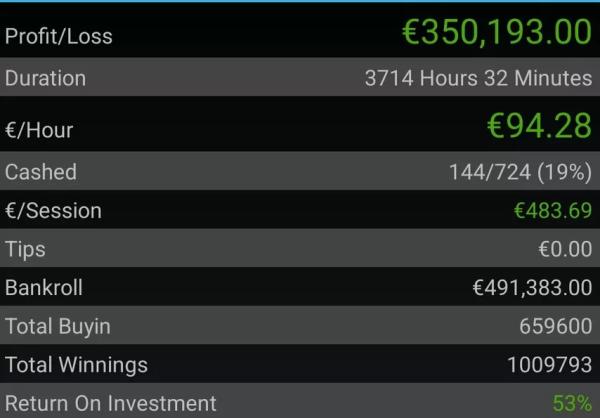
P.S. An example of ROI from the comments to the article. Andreas Froli (online and offline professional, Omaha specialist):
Live MTT. Average buy-in is about 1k. In Vegas, he played only a thousand hours, while in the red, probably due to large fields. Only one ride in 90k. I’m thinking about playing only less than a thousand people in the future.